
Technique Tuesday - Let's mix some colour!

Technique Tuesday is our little creative corner where we slow down, learn one simple art skill together, and build confidence one playful technique at a time.

Colour has a beautiful way of awakening creativity. Sometimes all it takes is a brush, a few simple paint colours, and a willingness to experiment before something inside us begins to soften and come alive again. Learning about colour is not only about art theory or technical skills. It is about observation, curiosity, play, and discovering how colours interact with one another to create emotion, atmosphere, depth, and beauty.
One of the most joyful things about working with paint is realising that you do not need hundreds of expensive colours to create something beautiful. Some of the most gorgeous palettes begin with only a handful of basic colours mixed thoughtfully by hand. When we learn to mix our own colours, we begin to understand paint in a completely different way. We learn how warmth and coolness affect a page. We learn how muted colours create softness and peace. We learn how vibrant colours bring energy and movement. Most importantly, we stop being afraid to experiment.
Colour mixing also slows us down in the best possible way. It encourages us to notice tiny shifts in tone and value. A little more white changes the softness of a pink completely. A touch of blue can calm a bright coral into something dusty and romantic. These tiny adjustments train our creative eye and build confidence over time.

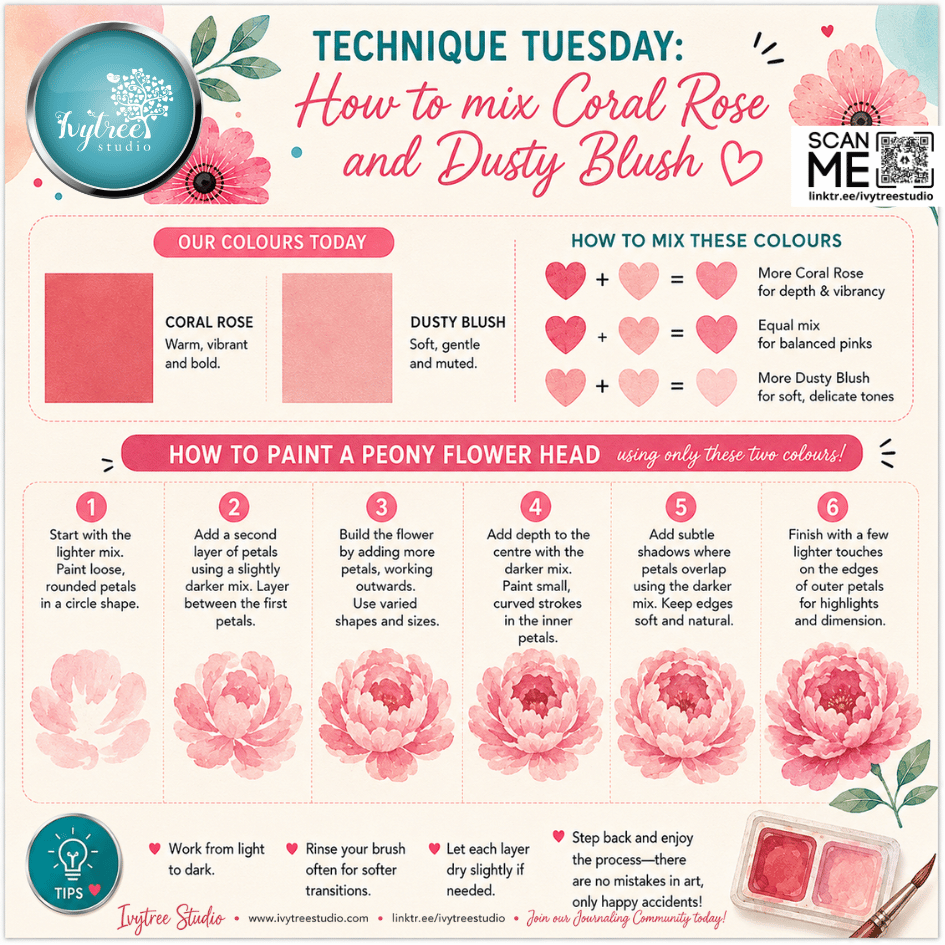
This week in Technique Tuesday, we are exploring two handmade colours: Coral Rose and Dusty Blush.
Together, they create a soft, painterly palette that is perfect for expressive florals and gentle mixed media work.
Today we are mixing colour from scratch and creating a soft, painterly Peony using only TWO handmade colours: Coral Rose and Dusty Blush. No fancy paint colours are needed — just your basic acrylic paints and a willingness to play.
CORAL ROSE:
To create Coral Rose, begin with three parts red and one part yellow.
Mix these together until you have a bright orange-red coral base.
Slowly add two parts white until the colour softens into a warm coral pink.
If the colour feels too bright or neon, add the tiniest touch of blue to gently mute it into a softer, more vintage coral tone.
Acrylic paint lightens quickly, so add white slowly and build the colour gradually.
DUSTY BLUSH:
Next, we create Dusty Blush.
Start with one part red and four parts white to create a soft baby pink.
Add a tiny touch of yellow and then the smallest touch of blue or brown. This mutes the brightness and transforms the colour into a romantic dusty pink.
You can adjust the final tone easily. More white creates a softer blush, more red creates a richer pink, and a little more blue or brown creates an earthier vintage tone. Dusty colours happen when bright colours are softened slightly with earthy or opposite tones.
Once your colours are mixed, it is time to paint the Peony.
Using Dusty Blush mixed with extra white, begin by painting loose petal shapes in a rough circular formation. Keep your strokes soft and sketchy and allow some of the white paper to show through. This first layer is simply about creating movement and softness.
Next, use pure Dusty Blush to add a second layer of petals between the first petals. Let the petals curve and ruffle naturally. Peonies are beautifully imperfect flowers filled with layered movement and softness, so do not aim for perfection.
Once your flower begins to take shape, switch to Coral Rose to build depth. Add darker petals toward the centre of the flower using shorter brush strokes and smaller petal shapes. This creates dimension and gives the flower that lush peony fullness.
For the centre, mix Coral Rose with a tiny touch of red and use small dabbing strokes to suggest detail and texture. The centre does not need to be overly detailed. Loose and painterly works beautifully here.
To soften the flower and create a dreamy painted effect, use a damp brush with a little white paint to gently blend some of the edges between petals. Finally, add a few highlights using white mixed with a touch of Dusty Blush along the outer petals and edges.
Remember that peonies are layered, expressive, and imperfect. Let petals overlap naturally. Let colours blend softly into one another. Let brush marks remain visible. The beauty often lives inside those imperfect painterly moments.
There truly are no mistakes in art — only beautiful layers, learning experiences, and happy accidents. Stay tuned for some more Ivytree Studio Colour Stories.

If you enjoyed today’s Technique Tuesday activity and would love to continue exploring colour, creativity, journaling, and gentle art techniques with us, I would love to invite you to join the Ivytree Studio Subscribers Community (Click the top link in my Linktree) or the Artful Ways Membership. Inside our creative spaces, we learn together step-by-step through devotionals, creative prompts, art journaling projects, colour studies, printable resources, and a beautiful, supportive community of creative women who simply want to grow creatively and spiritually one page at a time.
© Ivytree Studio. All rights reserved.
Stay Connected
🌸 Explore more resources: linktr.ee/ivytreestudio
📖 Grow your faith creatively with our Artful Ways Membership
🛒 Browse our latest journaling kits in the Ivytree Studio Store
“Thank you for reading! My prayer is that this post blesses your Faith, Emotional, and Creative Life. Stay rooted in God’s Word.”


Categories
© 2026 Ivytree Studio


